A blood panel and a wearable measure different things at different speeds. Blood is drawn twice a year and tells you what is happening inside cells, organs and arteries. A ring or a watch samples every night and tells you how you slept, how hard your heart worked, and whether you recovered. Neither replaces the other. Read together, each explains results the other cannot. This guide covers what Apple Health, Oura, Withings and Fitbit data add to a panel, how Clare connects them, and what to ignore.
What a wearable measures well
- Sleep duration and timing. The most reliable wearable metric, and the one that most affects blood results.
- Resting heart rate. A low, stable resting heart rate tracks with cardiovascular fitness. A sudden rise usually means illness, alcohol, poor sleep or overtraining.
- Heart rate variability. The variation in time between heartbeats, which reflects the balance of the nervous system. Higher generally means better recovery; the trend for one person matters, the comparison between people does not.
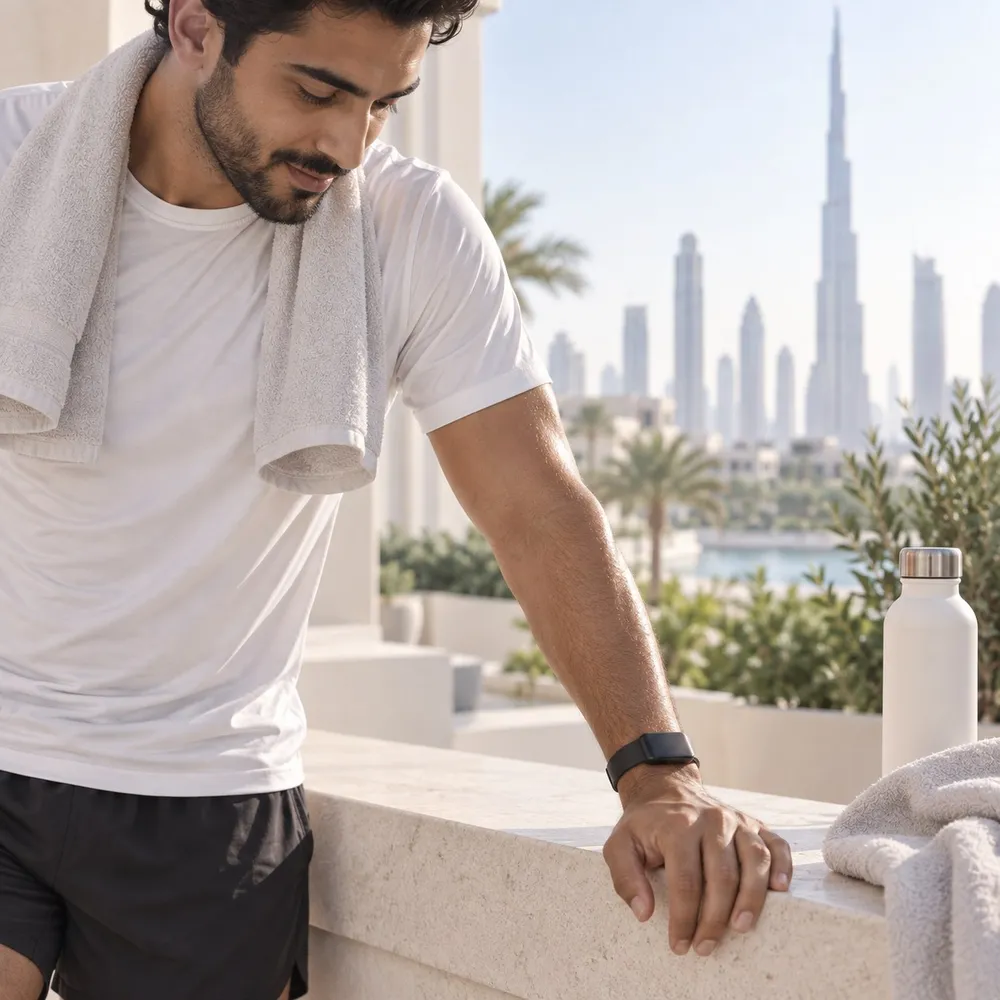
- Steps and active minutes. Approximate but consistent, and the single most useful input for someone in the UAE, where eight months of heat make movement something you have to plan.
- Skin temperature. Rings detect small overnight changes that often precede illness by a day.
- Weight and body composition, from a connected scale such as Withings, which is more useful than the scale in a bathroom because it records the trend.
What it measures badly
Calories burned are a rough model and should not be used to decide what to eat. Blood oxygen on a wrist is fine for spotting a pattern and poor at any single reading. Sleep staging, the split between deep, light and REM, is a guess from movement and heart rate and disagrees with a sleep laboratory a good part of the time. Read those as suggestions, not measurements.
Where the two sets of data meet
Sleep and glucose
A single night of four or five hours raises next-morning fasting glucose and insulin in healthy adults, and a fortnight of short sleep produces insulin resistance measurable in a lab. If a panel shows a high fasting insulin, a wearable that shows six hours of sleep on weeknights has already explained part of it, and a plan that starts with sleep rather than diet is the right one.
Resting heart rate, HRV and inflammation
A resting heart rate that has crept up over months and an HRV that has dropped often sit beside a raised hs-CRP. Neither is diagnostic, but together they say that something has been asking more of the body than it has been giving back, and they narrow the question.
Activity and lipids
Triglycerides and HDL respond to regular movement within weeks. A step count that averaged 4,000 a day through a Dubai summer and a triglyceride level that rose at the retest are the same fact seen twice.
Temperature, HRV and the day you were drawn
A blood draw the morning after a poor night, a late flight or the first day of a cold gives a worse result than the same body would produce a week later. Clare looks at the nights before a draw and flags a panel that was taken on a bad day, so a strange result is questioned before it is acted on.
Connecting devices to Clare
On iPhone, Clare reads from Apple Health, which means anything that writes to Apple Health, including Apple Watch, Oura, WHOOP, Garmin and most scales, arrives that way with your permission for each data type. On Android, the equivalent is Health Connect. Oura, Withings and Fitbit can also be linked directly through their own accounts, which brings in the metrics those services keep to themselves.
You choose which types to share, you can switch any of them off, and data that arrives from a device is stored under the same UAE Personal Data Protection Law terms as your blood results: encrypted, visible to you and to the clinicians involved in your care, never sold and never used to train anything.
What Clare does with it
The wearable data sits on the same timeline as the two panels, so when a marker moves between the first draw and the retest, the months in between are not blank. Clare AI answers questions about your own data across both sources, so "why is my fasting glucose higher than last time" can be answered with your sleep in the weeks before the draw rather than with a generic list of causes.
What Clare does not do is turn a wearable into a medical device. A low blood oxygen reading or an irregular rhythm notification from a watch is a reason to see a doctor, and the app will say so. It is not something Clare will interpret.
A practical setup
- Wear the device to bed. Night data is the useful part.
- Connect it in Clare before the first draw so the weeks leading up to the panel are on record.
- Look at weekly averages, not single days.
- Draw blood after a normal week, and let Clare tell you if it was not one.
- Shaffer and Ginsberg, An overview of heart rate variability metrics and norms, Frontiers in Public Health (2017) https://www.frontiersin.org/articles/10.3389/fpubh.2017.00258/full
- Spiegel et al., Impact of sleep debt on metabolic and endocrine function, The Lancet (1999) https://www.thelancet.com/journals/lancet/article/PIIS0140-6736(99)01376-8/fulltext
Last updated